
Penticton Housing Market Update – September 2026
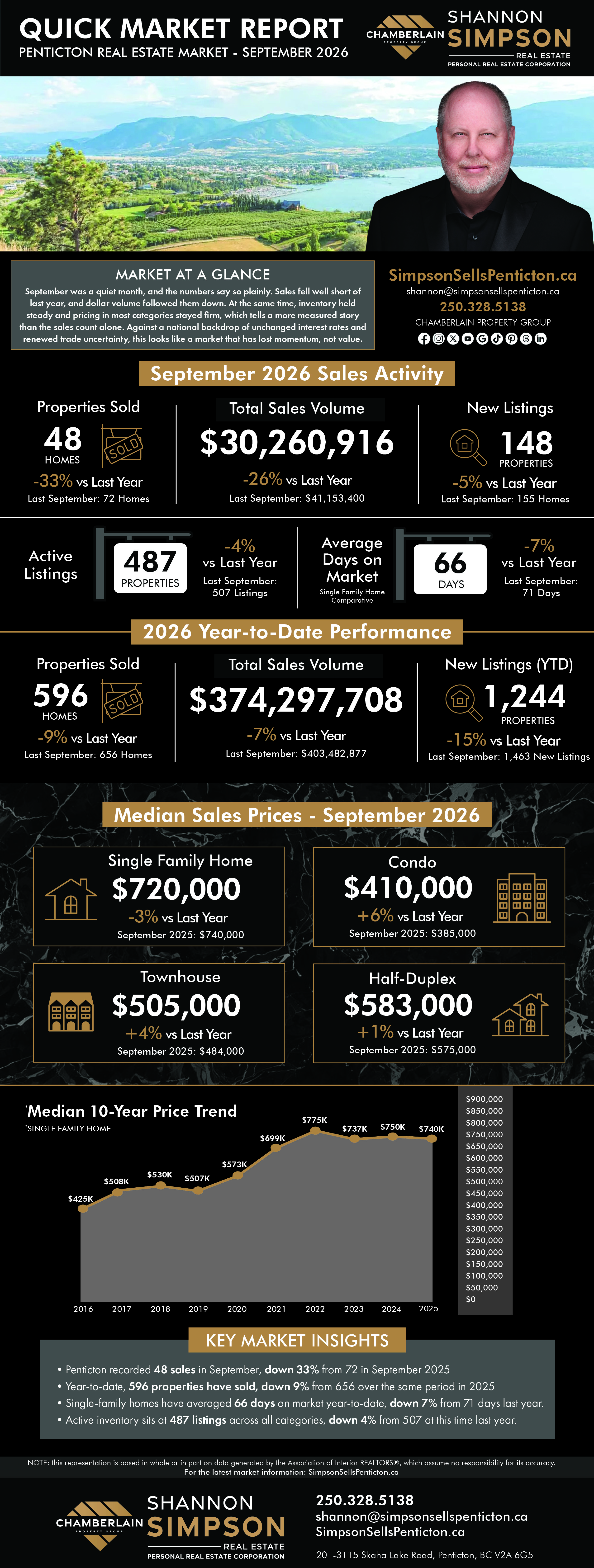
September was a quiet month, and the numbers say so plainly. Sales fell well short of last year, and dollar volume followed them down. At the same time, inventory held steady and pricing in most categories stayed firm, which tells a more measured story than the sales count alone. Against a national backdrop of unchanged interest rates and renewed trade uncertainty, this looks like a market that has lost momentum, not value.
Penticton recorded 48 sales in September, down 33% from 72 in September 2025, with total dollar volume of $30.3 million, down 26% from $41.2 million last year. Dollar volume fell less than unit sales, so fewer homes changed hands but the ones that did sold at higher prices; the average sale price rose to $630,436 from $571,575, lifted in part by four acreage sales averaging more than $1.1 million. On the supply side, 148 new listings came to market, down 5% from 155 a year ago. Year-to-date, 596 properties have sold, down 9% from 656 over the same period in 2025, with cumulative dollar volume of $374.3 million, down 7%. New listings for the year sit at 1,244, down 15% from 1,463. The turn in the year-to-date numbers is the real story: through May, sales were running 5% ahead of last year. Through September, they are 9% behind. Summer did not carry the spring’s momentum forward.Prices and Property Types:
Single-Family Homes: The year-to-date median sits at $720,000, down 3% from $740,000 at this point last year. September on its own was firmer: 20 detached homes sold at a median of $725,000, compared with $697,500 last September. Twenty sales is a small sample, but it is consistent with detached pricing finding its footing rather than sliding further.Condos: The year-to-date median is $410,000, up 6% from $385,000. Condos remain the steadiest performer in the attached segment, and with 13 sales in September they were the second most active category after single-family homes.
Townhouses: $505,000 year-to-date, up 4% from $484,000. Still positive, though only three townhouses sold in September, compared with ten a year ago. The price gains are holding; the volume is not.
Half-Duplexes: $582,500 year-to-date, up 1% from $575,000. Essentially flat. Gains in this category have narrowed steadily over the summer, and half-duplexes are now treading water rather than climbing.The pattern of the past year still holds in broad strokes: attached housing is posting modest gains while detached pricing sits slightly below last year. What has changed is the size of the gap. Attached gains have narrowed to the low single digits, and the detached decline has eased to 3%. Pricing across the board is converging toward flat, which is a calmer picture than the sharp split we saw in the spring.
Market Pace and Inventory:
Single-family homes have averaged 66 days on market year-to-date, down 7% from 71 days last year. In September alone, the detached homes that sold did so in an average of 41 days, compared with 62 days a year ago, so well-priced homes are still moving quickly. Active inventory sits at 487 listings across all categories, down 4% from 507 at this time last year. That figure needs context. In May, inventory was 18% below last year, a gap of more than 100 homes. At the end of September the gap was 20. Our own inventory has held remarkably steady, between roughly 485 and 500 listings since spring; what has changed is that last year’s comparison has fallen to meet it. With sales slowing, months of supply rose to 7.5, up from 7.2 last September.
What This Means for You:
- For sellers: September is a clear signal that buyers have become more selective. With 7.5 months of supply, the homes that sell are the ones priced correctly from the first day. Attached properties are still holding modest year-over-year gains and detached pricing is close to last year’s level, so there is no need to discount heavily. There is, however, a real cost to starting high and chasing the market down through the fall and winter. Homes sold for an average of 92.8% of list price in September, so the gap between asking and selling is meaningful.
- For buyers: This is the most room to negotiate buyers have had in some time. More supply relative to sales and sellers heading into the quieter season both work in your favour. Choice is still slightly narrower than a year ago, but that gap has almost closed. Borrowing costs have been unchanged for nearly a year, which makes planning straightforward. If you have been waiting for leverage, the next few months are likely to offer it.
- For everyone: September’s data marks a shift in tone. The year began with buyers showing up and sellers holding back; it is heading into winter with sellers on the market and buyers taking their time. That is a normalization, not a crisis, but it does change the right strategy on both sides of a deal.
My Take:
September was the weakest month we have seen in some time, and I am not going to dress it up. Forty-eight sales is down a third from last year, and year-to-date sales have gone from 5% ahead in May to 9% behind today. The summer simply did not deliver. Part of that is likely the Summerland wildfire in August, which brought showings across the region to a near standstill for close to two weeks, and some of the deals that would normally have firmed up in September were never written. But I would not hang the whole month on the fire. July sales were already down 11% year-over-year, so the slowdown was building before it.
The number I am watching most closely is months of supply. At 7.5 months, up from 7.2 a year ago, it sits well into what is generally considered buyers’ market territory, and it has drifted higher because sales have slowed while inventory held steady. The early October numbers suggest that is not about to reverse, with 11 sales in the first nine days of the month.
On the wider economy, the Bank of Canada held its key lending rate at 2.25% on September 2, its seventh consecutive hold, and most economists expect it to stay there through the rest of the year; the next decision is October 28. Second-quarter growth came in stronger than expected, which takes further cuts off the table for now, while high energy prices and the breakdown of trade talks between Canada and the United States, followed by new tariffs and counter-measures, have added a fresh layer of uncertainty. None of that is unique to Penticton, but it weighs on buyer confidence, and confidence is exactly what September was short on.
Here is the encouraging part: prices have not cracked. The attached categories are still up year-over-year, the single-family median is within 3% of last year, and the detached homes that sold in September sold quickly. Inventory has been steady since spring, and the gap with last year has nearly closed. As we move into the traditionally quieter months, I expect buyers to hold more leverage than they have at any point in 2026. Sellers who price with that in mind will still sell. Sellers who price for last spring’s market will likely be waiting for next spring’s.
Remember, if you have any questions, I’m always here to help you MAKE SENSE OF IT ALL!